
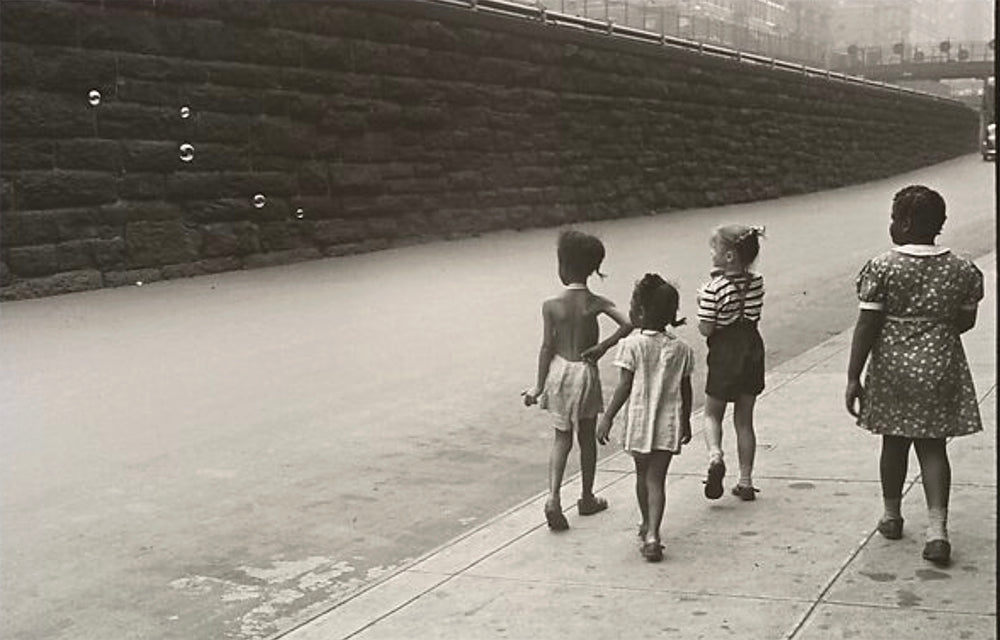
Helen Levitt (1913-2009) was a renowned American photographer, widely celebrated for her street photography, particularly in New York City. Her work captured the daily lives of ordinary people, often focusing on children, and is notable for its spontaneity and empathy. Levitt's images are considered among the finest examples of the documentary photography genre, and she played a crucial role in shaping the visual language of the 20th century.
Helen Levitt was born in Brooklyn, New York to a Russian-Jewish immigrant family. After high school, she took a job in a commercial portrait studio, where she learned the basics of photography. Her early exposure to the world of photography came through her work at the portrait studio and her encounter with photographer Henri Cartier-Bresson in 1935. Cartier-Bresson's work had a profound influence on her, particularly his use of the Leica camera and his concept of the "decisive moment." Levitt adopted the small, unobtrusive camera for her own work, allowing her to capture candid scenes on the streets of New York City without disturbing her subjects. Levitt was also influenced by the politically charged photography of the Workers Film and Photo League, a group she joined in the 1930s. The League focused on documenting social issues and poverty, which aligned with Levitt's own interest in the lives of everyday people. Towards the end of the 1930s, Levitt began to document the vibrant street life of New York's poorer neighborhoods, particularly in Harlem and the Lower East Side. Her photographs from this period are known for their attention to the gestures and interactions of children, who were often seen playing in the streets. These images, characterized by their sense of humor and humanity, became some of her most iconic works.
Levitt's photography was first recognized in the late 1940s when her work was featured in a solo exhibition at the Museum of Modern Art (MoMA) in New York. Her 1943 exhibition, "Helen Levitt: Photographs of Children," was curated by Edward Steichen and brought her significant attention. Despite this early success, Levitt remained somewhat under the radar, avoiding the commercial aspects of the art world and focusing instead on her work.
In addition to her photography, Levitt also worked in film. She was a cinematographer for the 1948 short film "In the Street," which she co-directed with James Agee and Janice Loeb. The film, like her still photography, captured the life of children on the streets of New York. Levitt later worked as an editor on the documentary films of Luis Buñuel and Sidney Meyers.
Levitt continued to photograph the streets of New York throughout her life, capturing the changing urban landscape. In the 1960s, she began experimenting with color photography, using Kodachrome film, which resulted in a vibrant new body of work. Her color photographs were published in the 2005 book "Slide Show," which renewed interest in her work.
Despite her reluctance to engage in the commercial art scene, Levitt received significant recognition later in her life. She was awarded two Guggenheim Fellowships, in 1959 and 1960, and her work has been collected by major institutions, including the Museum of Modern Art, the Metropolitan Museum of Art, and the Art Institute of Chicago. Passing away in 2009, Levitt’s legacy is one of powerful, poetic images, which continue to influence photographers and artists around the world.
GALLERY M is proud to represent select works of Helen Levitt's photography. Contact a consultant at 1.877.331.8401 or online for specific details including availability and pricing.
