
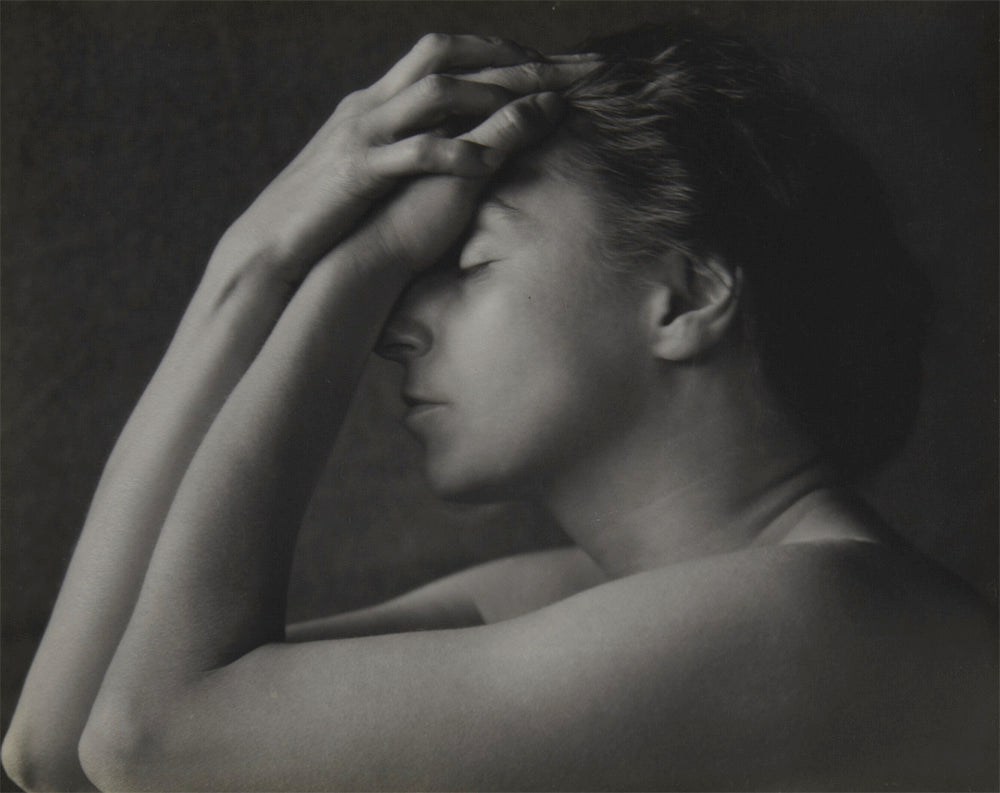
Edward Weston (American, 1886–1958) was a pioneering modernist photographer whose sharply focused black‑and‑white images of landscapes, nudes, still lifes, and everyday objects helped define 20th‑century fine art photography. Among the most innovative and influential American photographers of the 20th century, Weston transformed how the world perceives ordinary form — elevating shells, peppers, rocks, and the human figure into timeless sculptural abstractions.
Born on March 24, 1886, in Highland Park, Illinois, Weston received his first camera from his father at age sixteen. He studied at the Illinois College of Photography beginning in 1908, then relocated to California — the landscape, coast, and light of which would define his visual identity for the rest of his career. He established himself as a skilled portrait and commercial photographer in Tropico (now Glendale), California, producing polished work in the prevailing soft-focus Pictorialist style.
A decade into his career, Weston underwent a decisive aesthetic transformation. Rejecting Pictorialism's painterly softness, he developed the rigorous "straight photography" approach — images of uncompromising sharpness, precise composition, and rich tonal range that honored photography as its own distinct medium. This evolution accelerated during his years in Mexico City from 1923 to 1926, where he worked alongside photographer Tina Modotti and immersed himself in the post-revolutionary cultural milieu of Diego Rivera, José Clemente Orozco, and other leading modernist voices. The formal clarity of Mexican muralism deepened his commitment to objectivity in the photographic frame.
Returning to California in 1927 and settling near Carmel, Weston began producing the iconic body of work that secured his place in art history. Working with an 8×10 large-format view camera and his signature technique of "previsualization" — composing the final print entirely in the mind before releasing the shutter — he created intimate close-up studies of natural and found forms. His green pepper series, culminating in Pepper No. 30 (1930), stands among the all-time masterpieces of photography: an organic form rendered with such luminous precision that it transcends its subject entirely.
In 1932, Weston co-founded Group f/64 with Ansel Adams, Imogen Cunningham, and fellow West Coast photographers. Named for the small lens aperture that produces maximum depth of field — placing foreground and background in simultaneous sharp focus — Group f/64 became the defining manifesto of American modernist photography. Their debut exhibition at the de Young Museum in San Francisco announced a new visual standard: honest, formally disciplined, and unapologetically photographic.
In 1937, Weston became the first photographer in history to receive a Guggenheim Fellowship — a landmark institutional recognition of photography as a fine art. Over the following two years he traveled throughout the American West, producing nearly 1,400 negatives. This work was collected in the 1940 publication California and the West, cementing his reputation as the defining visual chronicler of the American landscape.
Weston continued working through 1948, when Parkinson's disease ended his ability to photograph. He died on January 1, 1958, at his home in Carmel, California. His archive is preserved at the Center for Creative Photography at the University of Arizona, and his prints hold permanent places in the collections of the Metropolitan Museum of Art, SFMOMA, the National Gallery of Art, the Museum of Modern Art, and institutions worldwide.
His influence extends across generations — from Minor White and Aaron Siskind to contemporary practitioners at the intersection of nature, form, and perception. For collectors, a Weston print is a core benchmark: a work that connects early American modernism to every photographic movement that followed, holding institutional and market significance across decades.
Weston’s photographs now reside in leading museums and institutions around the world, and his disciplined, form‑driven vision continues to shape the work of contemporary photographers, curators, and collectors. His images remain crucial reference points in exhibitions and scholarship on the history of photography, demonstrating the expressive power of straight photography from intimate still lifes to expansive Western landscapes. For collectors, Weston’s work serves as a core benchmark for building a historically grounded photography collection that connects early modernism to subsequent photographic movements.
Key works and museum presence include:
- Pepper No. 30 (1930), a landmark still life whose sculptural form and luminous detail exemplify Weston’s modernist vision; held in major museum collections, including SFMOMA.
- Pepper (1930), another widely collected image from the pepper series, underscores his break from Pictorialism toward pure form and clarity.
- Nautilus (1927), a dramatically lit nautilus shell now in the Metropolitan Museum of Art and the National Gallery of Art, celebrated as a masterpiece of modernist photographic still life.
- Ongoing retrospectives such as “Edward Weston, Modernity Revealed” and large surveys in European museums, presenting more than 100 vintage prints that trace his evolution from Pictorialism to mature modernism.
View a select grouping of Edward Weston works online here or speak with a GALLERY M specialist today. 